Scientific reading · Methods and interpretation
Tirzepatide trial windows
How earlier treatment, randomization and follow-up define the evidence behind a formulation claim.
AI-assisted editorial analysis; not medically reviewed. General education, not personal treatment advice. Publication disclosure.
A treatment result has a starting point. Someone beginning an intervention and someone continuing it after earlier exposure may appear at the same position on a chart, yet represent different scientific questions. Reading a tirzepatide timeline means separating elapsed time from treatment history: what happened before assignment, what comparison began at assignment, and which later measurements entered the analysis.
This article uses the trial-window diagram to develop those distinctions. The numerical intervals belong in the figure; the discussion explains how to reason from its structure without turning line length into an outcome. That approach also clarifies a question relevant to compounded preparations: which features of the studied exposure would need connecting to a different preparation before the original evidence could support a new clinical claim?
Study context
- A common origin
- Moving the time origin preserves durations while making the assignment boundary visible. [2]
- History matters
- Equal follow-up lengths do not make initiation and continuation the same scientific comparison. [2]
- People and observations
- An analysis can retain an earlier measurement while excluding a later measurement from the same person. [2]
- Two kinds of grouping
- Treatment allocation and classification by a subsequent experience have different causal interpretations. [2]
Trial windows
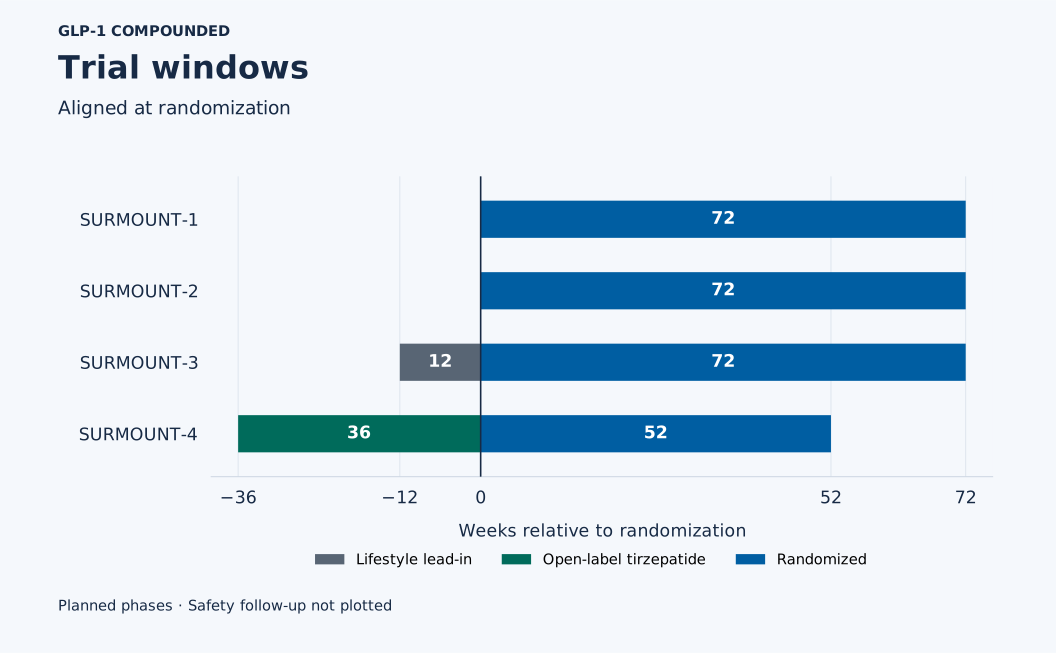
| Trial | Before randomization | Randomized phase |
|---|---|---|
| SURMOUNT-1 | None shown | 0 to 72 |
| SURMOUNT-2 | None shown | 0 to 72 |
| SURMOUNT-3 | Lifestyle: −12 to 0 | 0 to 72 |
| SURMOUNT-4 | Drug: −36 to 0 | 0 to 52 |
Download: SVG figureCSV data
Randomization as a common origin
The zero on this diagram is an editorial choice: randomization, the point of treatment assignment. Earlier phases receive negative coordinates. Those coordinates describe position relative to the chosen boundary; they are not the original study-week labels. This is a change of reference point, much as a map can measure distances from a station instead of a city boundary. The underlying intervals remain the same.
Consider a purely illustrative experiment whose original clock places assignment at week five and a later visit at week eight. On a clock centered on assignment, that visit falls at plus three. An earlier visit at original week two falls at minus three. Subtracting the same number from every date changes neither the distance between visits nor their order. It also supplies no information about what happened at either visit.
The alignment therefore makes one question easier to inspect: how much scheduled time lies on either side of assignment? It does not reset prior exposure, erase earlier changes, or place participants in identical starting states. A blank area before zero means the diagram has not drawn a phase there. Treating that blank as proof that no screening, preparation or other procedure occurred would add information the graphic does not contain.
Sources [2]
Equal duration, different histories
Duration is one coordinate of an experiment, not a complete description of its comparison. An initiation question asks about beginning an intervention under specified conditions. A continuation question asks about the next stage after some earlier exposure. A withdrawal question compares strategies that diverge after a shared history. Giving these questions equally long observation windows would not make them interchangeable, because their starting conditions remain part of what is being tested.
Imagine two otherwise unspecified experiments, each with a final measurement the same number of weeks after assignment. In one, the relevant exposure begins at assignment. In the other, it began beforehand. The second experiment has an additional history to describe even if its postassignment line looks identical. Without that description, a reader could mistake the effect of a later strategy for the effect of starting the whole treatment sequence.
The table separates these questions conceptually. It does not rank the trial rows or report additional results. Equal calendar lengths also say nothing about how many observations were collected within them. For terminology about the medication itself, the tirzepatide guide provides a separate starting point; the scientific comparison still needs its own history, comparator and measurement rule.
| Design question | What to inspect | Interpretation limit |
|---|---|---|
| Initiation | Exposure before assignment and the strategy that begins afterward | A starting-treatment question needs its own defined starting population. |
| Continuation | The shared earlier exposure and the next assigned strategy | Later experience need not describe every original starter. |
| Withdrawal | The common history before strategies diverge | The contrast concerns subsequent strategies within that history. |
Sources [2]
A lifestyle phase before assignment
A phase before randomization can shape both the condition in which people arrive at assignment and who reaches that boundary. These are different effects. Earlier activities might change a measured characteristic within a person. Separately, an entry rule or the ability to complete preliminary procedures might determine membership in the later study population. A timeline can identify where to ask about these processes without measuring their size.
For illustration, suppose a hypothetical study recruits volunteers, offers a preliminary program, and then assigns eligible participants to two subsequent strategies. The randomized comparison begins within that later group. It does not automatically compare the complete sequence with doing nothing from recruitment onward. To answer that broader question, the design would need a suitable comparison beginning at the earlier boundary, together with outcome information from that starting population.
This is the distinction between internal validity and applicability. Internal validity concerns whether the comparison supports an inference within the experiment. Applicability concerns whether that inference fits another population or setting. A preliminary phase can limit the second without automatically invalidating the first. The guide to GLP-1 eligibility addresses a different practical question; research eligibility must still be read from the particular study. Neither the presence nor length of a preliminary phase reveals how many people qualified.
Sources [2]
A drug phase before assignment
Earlier drug exposure adds a further question: what information about treatment experience exists by the time the randomized comparison begins? A participant could already have a history of taking the intervention, attending assessments and encountering its effects. The scientific starting point then includes that history. Calling assignment the beginning of the experiment should not be confused with calling it the beginning of every participant’s exposure.
In a hypothetical design that requires reaching a later assignment visit, people who reach that visit may differ from those who do not. This is sometimes called selection of survivors, meaning survival through a study stage, not necessarily survival from a life-threatening event. The phrase identifies a possible selection process. It does not establish its magnitude, identify the reasons for earlier departures or prove that everyone remaining tolerated treatment well.
A complete assessment would compare the original entry population with the group at assignment and inspect the reasons for any differences. Without those records, line length cannot quantify selection. The useful interpretation is narrower: a result after earlier exposure answers a question conditional on reaching that later stage. Applying it to every new starter would require an additional argument about how the selected group represents those starters, including experiences that occurred before the randomized boundary.
Sources [2]
The contrast after withdrawal
A continuation-versus-switching design asks about two paths from a shared starting history. Its contrast is the difference between those subsequent paths under the study’s conditions. A change from the very beginning of the whole sequence answers another question. Both quantities can be informative, but their baselines differ. Confusing them can assign changes accumulated before randomization to the later randomized strategy.
Consider an invented outcome score, unrelated to body weight or any trial observations. Both hypothetical groups start the entire sequence at 100 and arrive at assignment at 80. Later, one group records 70 and the other 85. Changes from assignment are minus 10 and plus 5; changes from the original starting point are minus 30 and minus 15. The final between-group difference is 15 score units. The example shows why a baseline belongs beside a change estimate.
It does not show why either trajectory occurred, whether a difference is precise, or whether lower scores are desirable. Those questions require an outcome definition and actual data. Likewise, a phase diagram contains no measurements from which to calculate a treatment effect. Its contribution comes earlier in interpretation: it identifies the decision boundary so the reader can recognize which comparison a later estimate would describe and which earlier changes remain outside that contrast.
Sources [2]
A trial phase is not every observation
Three clocks can coexist: the scheduled intervention phase, the period in which symptoms are sought, and the observations eligible for a particular analysis. They need not share an endpoint. SURMOUNT-4 gastrointestinal reporting includes safety follow-up. The diagram displays planned phases, so its right-hand edge must not be treated as the last possible safety observation. No additional follow-up duration can be read from an unextended line.
For a hypothetical record, a symptom might be documented after a scheduled treatment phase ends. That record could belong in a safety account while a different analysis follows another inclusion rule. Conversely, scheduling a visit does not prove an observation was obtained. A useful methods check therefore asks three separate questions: when was information sought, what was actually recorded, and which records contributed to the stated result? Each concerns a different part of measurement.
Current safety context is separate: ZEPBOUND and WEGOVY labels warn about severe gastrointestinal reactions and acute kidney injury with volume depletion; neither is recommended for severe gastroparesis. This brief context is not a complete prescribing summary. The side-effect guide addresses symptom-related care questions. For reading the research, the immediate task is to keep a schedule, an observed symptom and an analyzed measurement distinct; a single colored segment cannot stand in for all three.
What the analysis keeps
Efficacy analyses excluded measurements after treatment discontinuation. This is a rule about observations, and it must be distinguished from deleting a participant’s entire history. An estimand is the precise effect a study seeks to estimate: it ties together a population, treatment comparison, outcome, time point and handling of events that interrupt the original treatment plan. The observation rule helps explain the question being answered.
As an illustration, imagine one person with several measurements before stopping an assigned intervention and another measurement afterward. A rule excluding the later measurement can leave the earlier records eligible. Counting the person as entirely absent would misdescribe that rule. At the same time, retained early records are not equivalent to observing that person through the final time point. The distinction matters whenever readers try to infer complete follow-up from a participant count.
Excluding later data can also create a scientific dependency: the observed later group may depend on who continued. If continuation relates to outcomes, simple comparisons among remaining observations can be affected. This is a reason to inspect the estimation method and its assumptions, not a license to declare the direction or size of bias. A timeline alone cannot resolve missing information, demonstrate that an assumption holds, or reconstruct the outcomes that would have been observed under another strategy.
Sources [2]
Symptoms recorded after assignment
Symptom groups were not randomized. The general reasoning is straightforward: assigning a treatment by chance does not assign every later experience by chance. Classifying people according to something that happens afterward creates a new comparison. Its groups may differ in other ways connected with that experience, even when the original treatment arms were formed through random assignment.
Consider an illustrative classification based on whether someone reports a symptom during observation. Membership can reflect the experience itself, opportunities to observe it and whether it was reported. A person observed longer might have more opportunities to enter the reported-symptom category. These are possibilities to investigate, not explanations established for this study. A difference between such categories therefore cannot, by itself, isolate the biological effect of the symptom.
The same issue affects attempts to infer necessity: finding an outcome among people without a recorded symptom does not establish every pathway producing that outcome, while an association among those with symptoms does not prove causation. The companion analysis of semaglutide risk measurements examines another measurement problem: how a percentage is constructed. Read together, the methods questions distinguish the definition of a group from the construction of its statistic. Neither operation creates random assignment where it did not occur.
Transporting evidence to a preparation
Transportability means carrying an inference from one setting into another with an explicit argument about what remains comparable. For a preparation claim, that argument needs more than a matching ingredient name. The proposed connection might concern exposure, clinical outcomes or handling conditions. Each is a different proposition, and evidence that addresses one cannot silently substitute for evidence about the others.
A useful hypothetical comparison first specifies the target claim: similar exposure under defined conditions, for example, or similar measured outcomes in a defined population. It then identifies observations that could distinguish similarity from a meaningful difference. Failure to detect a difference would also need interpretation in light of measurement precision and study design. Simply choosing a familiar name supplies none of those observations. The compounded-versus-brand guide provides context for keeping product descriptions separate from clinical inference.
FDA says unapproved GLP-1 products lack its premarketing review for safety, effectiveness and quality. That approval boundary does not itself quantify any preparation’s clinical performance. The guide to added B12 ingredients raises a related evidence question without establishing an added benefit. The table maps possible claims to the kinds of connections a reader would need to examine; it makes no laboratory finding, provider assessment or equivalence determination.
| Claim about a preparation | Evidence needed | What these trials supply |
|---|---|---|
| Comparable exposure | A comparison addressing the relevant preparation and conditions | A starting context for identifying the exposure question. |
| Comparable clinical outcomes | A justified population, comparator, endpoint and observation window | Design questions to preserve when assessing a new comparison. |
| Comparable follow-up | Documentation of how observations are obtained and retained | A framework for distinguishing schedules from measured follow-up. |
Reading the timeline with its limits
Lilly funded this research. A funding disclosure belongs beside an evaluation of the methods; it does not replace that evaluation in either direction. Relevant questions include whether the comparison is specified clearly, whether the observation rule matches the stated question, and whether the conclusions extend beyond the population and treatment history represented. Those questions remain useful regardless of a reader’s prior view of the sponsor.
The most revealing missing comparison is often the one implicit in a broad claim. A statement about every treatment starter implies a population beginning at initiation. A statement about another formulation implies a justified connection to that preparation. A statement about longer-term experience implies corresponding observations. Writing out the implied comparison exposes what additional evidence would be needed; it is more informative than treating any single study duration as a general guarantee.
In practical document review, this is editorial interpretation rather than a study finding. The CoreAge Rx review and Henry Meds review can serve as places to begin checking documentary terms: what product description, follow-up arrangement and source documentation are actually stated? Those checks concern the documents under review. A research timeline cannot verify them or assign a provider an outcome. Keeping that distinction visible lets a scientifically useful result retain its value without expanding its claim.
Questions
Why are some timeline weeks negative?
They locate an earlier phase relative to the zero chosen for this illustration. The sign describes position, not a negative duration, a clinical result or the original report’s week label. To translate a point between two clocks, shift the origin consistently for every point. The spacing between points stays unchanged. This makes the assignment boundary easier to compare while preserving the distinction between earlier history and the later randomized period. [2]
Does a longer line imply a better treatment?
Line length encodes scheduled time. Judging benefit would require an outcome, an appropriate comparison and an estimate with its uncertainty. Longer observation can create more opportunities to measure change, but it also creates more opportunities for missing records and changes in exposure. Without those observations, the diagram cannot decide whether a treatment worked better, whether symptoms were more common or whether a different preparation would perform similarly. [2]
Does excluding later observations remove an entire participant?
An observation rule and a participant rule operate at different levels. In a hypothetical record, an earlier measurement can remain eligible when a later one falls outside the analysis window. That does not make the later outcome known, nor does it tell the reader how an estimator handles the gap. Inspecting both rules is necessary before treating a reported participant total as evidence that every person contributed a complete measurement sequence. [2]
Are symptom groups randomized groups?
Random assignment governs the intervention allocated at the chosen starting point. Dividing people by a later experience does not create a second random experiment. To interpret that later comparison causally, researchers would need additional assumptions and methods addressing other differences between groups. The relevant questions include when classification became possible, how consistently experiences were recorded and whether the same observation opportunities existed. A group label alone cannot answer them. [2]
What would connect a trial result to another formulation?
First define the proposed claim precisely. Similar ingredient descriptions, similar exposure and similar clinical outcomes are different claims. Then ask which comparison could test the chosen proposition, in which population and over which observation period. A credible connection also explains why any remaining differences would not undermine the inference. Without that argument, a preparation name and a trial citation sit beside each other; they do not yet establish the relationship being asserted. [2][5]
Editorial assessment
The timeline is most useful as a way to specify a scientific question. Identify the assignment boundary, describe the history before it, and separate the scheduled phase from the records entering an analysis. Then state the population and comparison to which a conclusion would apply. These steps explain why two lines can share a length while representing different evidence. They also make the remaining uncertainty concrete: another starting population, another preparation or another follow-up arrangement requires a reasoned connection and relevant observations. The drawing supplies orientation; the measurements and analysis must supply the result.
Evidence limits
This methods interpretation uses the full primary articles and actual supplementary documents, plus current official label and FDA material. It does not review individual participant records or complete trial protocols. Hypothetical examples are explanatory constructions, not trial observations. The diagram depicts planned phases rather than complete gastrointestinal ascertainment or safety follow-up. No clinical effect, event incidence, comparative drug ranking or formulation equivalence is calculated from its lines.
Sources
Research access: full articles and supplements. Official labels and FDA guidance were also checked. Individual participant records and complete trial protocols were not reviewed. Checked dates use UTC.
- Wharton et al. 2022Checked .
- Rubino et al. 2025Checked .
- DailyMed: Wegovy prescribing informationChecked .
- DailyMed: Zepbound prescribing informationChecked .
- FDA: Unapproved GLP-1 drugsChecked .